How to Find the Right Therapist for You: 8 Steps to Start Your Search
Clinically reviewed and contributed to by Adrienne Figueiredo, LCAT. Published October 3, 2025.
What’s the easiest way to find the right therapist?
In a nutshell:
Start by getting clear on what you’re looking for. Know your therapy goals (what you want out of therapy), understand different therapy types, and narrow your search using tools and filters that matter to you. Check out therapist directories, take advantage of free consultations, and trust how you feel during those early conversations.
Quick-start checklist:
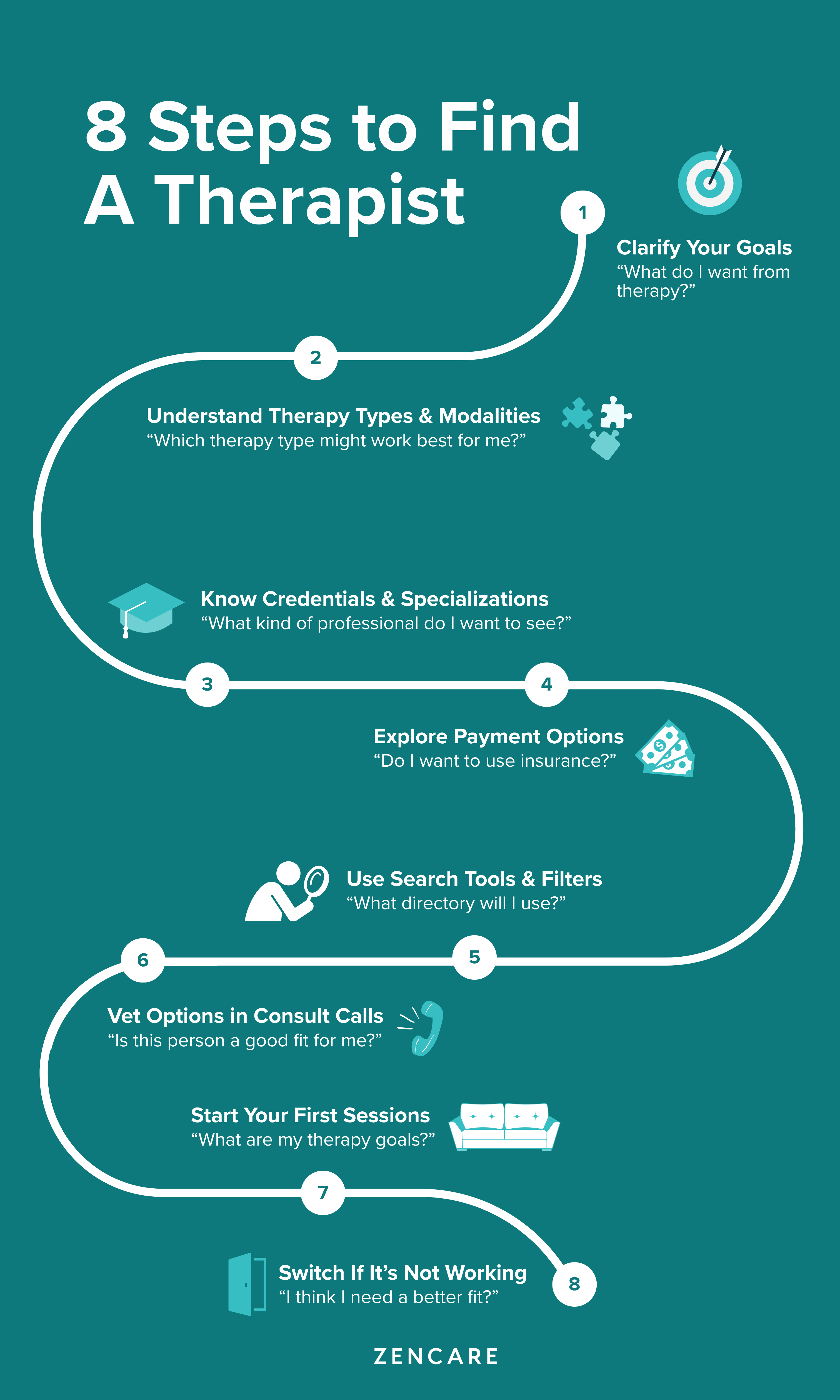
- Know what you want out of therapy
- Learn about therapy formats and styles
- Understand therapist qualifications
- Explore how you’ll pay, with or without insurance
- Use smart search tools and filters
- Ask key questions in consults
- Evaluate your first few sessions
- Be ready to switch if it’s not working
Why Finding the Right Therapist Matters
Let’s be honest. Searching for a therapist can feel overwhelming, especially when you’re already dealing with emotional stress or life changes. You’re not alone in that feeling, and you don’t have to have everything figured out to take the first step.
Therapy is a deeply personal experience. It’s not just about who’s available in your area or who takes your insurance. It’s about finding someone who helps you feel safe, seen, and supported. The right therapist can help you navigate challenges, build coping tools, and grow in ways that last.
This guide is here to break it all down into simple, doable steps. You’ll learn how to find the right therapist for you, based on your needs, your preferences, and your goals.

1. Clarify Your Goals: What Do You Want from Therapy?
Why do your therapy goals matter?
Before you start emailing therapists or scrolling through directories, take a pause and ask yourself, “What am I looking for in therapy?”
“If you’re unsure of what you’re looking for in therapy, you can ask yourself what isn’t feeling ‘right’ in your life. Is it a feeling you’ve been having (it’s ok if you can’t name the feeling!), a difficult experience with someone important to you, or just a general feeling of ‘stuckness’? Don’t let not having the right language stop you from reaching out — it’s our job to help you name it and ultimately work through it,” says Adrienne Figueiredo, LCAT.
Here are a few things people often want help with:
- Easing symptoms of anxiety or depression
- Processing trauma or loss
- Navigating a life transition like a breakup or move
- Improving communication in relationships
- Building confidence or better self-understanding
Some people want short-term support for a specific issue. Others are looking for long-term work that goes deeper into patterns and history. Knowing your goal helps you find a therapist whose approach matches your needs.
You’ll also want to think about personal factors. For example:
- Do you want a therapist who shares your cultural background?
- Is gender, race, or sexual orientation important in feeling understood?
- Are you looking for someone LGBTQ+ affirming or who specializes in neurodivergence?
The more clarity you have, the easier it becomes to narrow down your options.
Takeaway:
Your therapy goals shape everything else. Getting clear up front helps you find the right therapist for you, not just the next available one.
2. Understand Therapy Types and Modalities
What type of therapy is right for you?
Therapy isn’t one-size-fits-all. Different approaches, or modalities, are designed to help with different challenges. Understanding these basics will help you make a more informed decision.
Here are a few of the most common therapy types:
- CBT (Cognitive Behavioral Therapy): Focuses on identifying and changing unhelpful thought patterns. Great for anxiety, depression, and stress.
- Psychodynamic Therapy: Dives into your past and helps you make sense of how early experiences impact your present.
- EMDR (Eye Movement Desensitization and Reprocessing): Often used for trauma and PTSD.
- DBT (Dialectical Behavior Therapy): Combines mindfulness with emotional regulation. Helpful for mood swings, self-harm, and high emotional sensitivity.
And then there’s format:
- Individual therapy is a one-on-one experience, tailored to your personal growth.
- Couples therapy helps partners strengthen communication and connection.
- Family therapy works through dynamics between multiple family members.
- Group therapy brings people with shared concerns together for support and skill-building.
You’ll also want to think about how sessions happen:
- In-person therapy gives you face-to-face interaction and a structured setting.
- Online therapy (telehealth) makes it easier to fit sessions into your schedule and can be just as effective for many people.
Takeaway:
Choosing the right therapy type and format helps you get the kind of support that matches your situation and your style.
3. Know What Credentials and Specializations Actually Mean
What’s the difference between an LCSW, LMFT, PsyD, or psychiatrist?
Let’s decode the alphabet soup. Therapist titles can be confusing, but understanding them helps you make smarter choices.
Here are some of the most common licenses:
- LCSW (Licensed Clinical Social Worker): Often focuses on both emotional support and social context. Good for a holistic approach.
- LMFT (Licensed Marriage and Family Therapist): Specializes in relationship dynamics, often ideal for couples or family work.
- LPC or LPCC (Licensed Professional Counselor): Trained to support a wide range of mental health issues.
- LCAT (Licensed Creative Arts Therapist): Trained in utilizing visual, musical or movement-based expression in conjunction with more traditional therapy. Good for people who struggle to verbalize how they’re feeling, want to connect to more unconscious material, or just want to try something different.
- PsyD or PhD (Psychologists): Doctoral-level professionals with deep training in therapy and psychological testing.
- Psychiatrist (MD or DO): A medical doctor who can prescribe medication and often works in tandem with a therapist.
It’s not just about licenses though. Specializations and background really matter.
For example, you might want someone who is:
- Trauma-informed
- LGBTQ+ affirming
- Culturally competent
- Experienced with ADHD, autism, or chronic illness
- Skilled in addiction recovery or eating disorders
Takeaway:
When you understand what those credentials after a therapist’s name mean, and what they specialize in, you can choose someone who is truly equipped to help YOU.
4. Explore How to Pay: Insurance, Self-Pay, and Out-of-Network Options
How do therapy costs and insurance actually work?
Let’s talk about money, because therapy can be an investment, but it doesn’t have to be confusing.
If you have insurance:
- In-network therapists are contracted with your insurance company. You’ll usually pay a fixed copay per session. Many clients use their HSA cards to pay for their copay or their full session fee, which can help offset costs.
- Out-of-network therapists may give you a superbill to submit for reimbursement. It’s a bit more work, but still an option.
“Most people also have more out of network benefits than they realize, so if you find a therapist out of your network that you feel like you’d really click with, it’s absolutely worth it to explore that option. It’s also good to note that paying out of pocket keeps your information confidential and reduces insurance-based interference,” shares Adrienne Figueiredo, LCAT.
- Your plan may include deductibles and coinsurance too. That means you’ll pay a certain amount before insurance starts covering costs.
If you’re paying out of pocket:
- Some therapists offer sliding scale fees based on your income.
- Paying privately often gives you more flexibility, more privacy, and access to therapists who don’t take insurance.
Not sure what your plan covers? Call your provider or check your online benefits. Ask about mental health coverage, copays, and whether you need a referral.
Takeaway:
Understanding your payment options helps you plan ahead and reduce stress. You’ve got choices. Explore them.
5. Find Therapists Using the Right Tools and Filters
Where should you actually look for a therapist?
Once you know what you’re looking for, it’s time to start the search. Zencare is a great place to start. Zencare makes it easy to find vetted therapists based on what truly matters to you, like specialties, availability, format, and cultural alignment. Every therapist has a detailed profile that includes a video introduction, so you can get a sense of their vibe before reaching out.
“The video introductions make a big difference — you can get a great gauge on a therapist’s personality and the way they’ll work from those. Also, don’t hesitate to ask people you know! Although you can’t work with the same therapist as someone very close to you (it’s too hard for the therapist to be impartial), a lot of my clients have been referrals from other clients. If a friend relates to them, you probably will too,” shares Adrienne Figueiredo, LCAT.
Key features:
- Search by specialty, identity, format (in-person or telehealth), and insurance
- Watch therapist videos to get a feel for their style and approach
- Book free consults directly through the platform
- Browse therapists in your area or state-wide for telehealth options
Zencare is especially helpful if you’re looking for a more curated, user-friendly experience. Every provider is interviewed and background-checked, so you’re not left guessing about qualifications or approach.
Other helpful sources:
- Ask your primary care doctor for a referral
- Reach out to local LGBTQ+ centers, cultural organizations, or nonprofits
- Consider asking trusted friends or colleagues, if you feel comfortable
When using directories, filter by:
- Specialty: anxiety, trauma, relationships, etc.
- Identity alignment: BIPOC therapist, queer-affirming, neurodiversity-informed.
“This can take many forms; for instance, I’m very open about my first career as an artist, and that has helped me relate much more deeply to the many creative clients I have,” says Adrienne Figueiredo, LCAT.
- Logistics: online or in-person, location, availability, sliding scale
Try searching for “therapist near me” along with a few key terms like “CBT,” “trauma,” or “telehealth” to narrow things down.
Takeaway:
Use filters and tools that reflect your needs. They’ll help you skip the noise and zero in on the right options faster.
6. Vet Your Options: What to Look for in a Consult Call
What should you ask in a free consultation?
Many therapists offer free 10- to 20-minute calls so you can get a sense of whether you click. Here’s how to make the most of that time.
Questions to ask:
- Have you worked with people who’ve dealt with what I’m going through?
- How would you describe your therapy style?
- What does a typical session look like?
- Do you offer online therapy or just in-person sessions?
- What’s your availability like?
- What’s your cancellation or rescheduling policy?
- Do you recommend or prefer a certain length & frequency of treatment? For instance: once a week vs monthly, open-ended vs. short term.
- What is your cancellation & reschedule policy? This is especially important if you have an irregular schedule or travel a lot.
Green flags:
- They listen and reflect your concerns
- They seem open, warm, and non-judgmental
- They’re clear about how they work
- They invite your questions and input
- They seem distracted or rushed
- Their answers are vague or overly technical
- They dismiss your concerns
- Policies are unclear or feel rigid without explanation
Takeaway:
Trust your gut. The consult call is your chance to feel out the connection and get clarity on whether this therapist is someone you want to work with.
7. What to Expect in the First Few Sessions
What happens once you actually start therapy?
Those first couple of sessions aren’t meant to fix everything. They’re about getting the lay of the land.
“Typically, I’ll ask in the first session what the client’s goals are, and within the next session or two, I’ll give a bit of a roadmap of how I think we can achieve them. I’ll also give my feedback about what I think would be useful to focus on. This can shift over time, but it’s important that both parties are on the same page. I often say in my initial consultations that I believe therapy is very much a lateral relationship, not a hierarchical one!” explains Adrienne Figueiredo, LCAT.
“Also, the first 2-3 sessions are the chance for both parties to ensure that it’s the right fit. A good therapist will know when they can’t provide what someone is looking for, and you’ll likely know if it doesn’t feel right to you either. It is important to give it a real go, but after the 3rd session or so, you should trust your instincts. You can think of it as being akin to other medical care — a PCP wouldn’t be helpful if you need knee surgery, so it’s just about connecting with the right clinician.”
Here’s what usually happens in the first session with a therapist:
- You’ll share what brought you to therapy and your background
- Your therapist may ask about symptoms, history, and goals
- You’ll start building rapport and a sense of trust
- You might start setting goals for your time together
It’s totally normal to leave your first session feeling unsure. Therapy is vulnerable. Sometimes it takes 2 or 3 sessions to feel a sense of connection — or to realize it’s not the right fit.
Ask yourself:
- Do I feel safe opening up here?
- Do I feel respected and heard?
- Are we working toward goals that matter to me?
Takeaway:
Give it a few sessions before making a call. But don’t ignore your instincts, if something feels off, it’s okay to explore other options.
8. When It’s Not Working: How to Transition to a New Therapist
What if you realize the therapist isn’t a good fit?
It happens. Maybe the style’s off, maybe the vibe isn’t right, or maybe your needs have changed. Whatever the reason, switching therapists is valid. Direct, honest communication is always the best route here. It’s likely that the therapist will appreciate the feedback whether you end up continuing your work together or not — and if they don’t, then they’re definitely not the right fit!
Adrienne Figueiredo, LCAT does strongly recommend giving it about 3 sessions to really suss out if they’re right for you, but after that, it’s not too early to “break up”.
Here’s how to make a respectful exit:
- If you feel comfortable, talk about what’s not working. Some issues can be adjusted.It can be really difficult and vulnerable to do this, but it not only gives you a chance to receive the best care, but it’s also good practice in self-advocacy.
- Ask for referrals. A good therapist will want you to find the right support.
- Request your records or a brief treatment summary if you’re continuing care with someone else.
You don’t owe anyone an apology for prioritizing your well-being, and a good therapist would support you stepping away and finding a better fit.
Takeaway:
Ending therapy doesn’t mean you failed. Sometimes the most empowered step is finding someone who’s a better fit for you right now.
Your Path, Your Pace
You don’t need to have all the answers to get started. Finding the right therapist is a process. And like any process, it takes a bit of time, some trial and error, and a whole lot of self-trust.
Even taking the first step, reading this guide, scheduling a consult, or asking a question, is movement forward. Wherever you are in the process, that’s exactly where you’re supposed to be.
FAQs About Finding the Right Therapist, Answered by Adrienne Figueiredo, LCAT
How long does it take to find the right therapist?
This often depends on how much clarity you have on what you’re looking for in therapy. If you have a keen sense of that, you can likely narrow down your search pretty easily, but if not, you may need to try it out first to see what your real needs are.
Can I switch therapists if I don’t feel a connection?
Yes! While I do strongly recommend giving it 2-3 sessions, you should trust your instincts here. But first, let your therapist know what you feel isn’t working — there’s a good chance they can shift the type of work you’re doing, and either way, you’ve gotten some great practice navigating your needs in interpersonal relationships. Also, this is a two-way street — the therapist should also be communicating about what may be feeling “off” to them.
Is online therapy as effective as in-person sessions?
Absolutely! There are pros and cons to both; while it can help build the connection to be in person, doing therapy from home provides a great deal of comfort for many people. It also helps with continuity of care — while you might cancel a much-needed session if you’re under the weather & don’t want to commute, you can keep the session if you’re doing therapy virtually.
What should I do if I can’t afford therapy?
Look into sliding scale therapists, community clinics, and low-cost services. You should also consider and explore your out-of-network benefits, and use your HSA or FSA cards for payment. Some universities and training centers also offer reduced-fee sessions with supervised interns.
How do I find a therapist who understands my background?
Use filters like “BIPOC therapist,” “queer therapist,” or “culturally competent” on directories like Zencare. It’s okay to ask about a therapist’s lived experience or training during your consultation. Every therapist feels differently about personal disclosure, and should be trained to use it only in service of the client, but, many aspects of our identity are on full display, so it can be wonderful to be supported by someone who relates to your lived experience. On the other hand, it can also be really useful to have a therapist who is very different from you — it really depends on what you’re working on in therapy.